
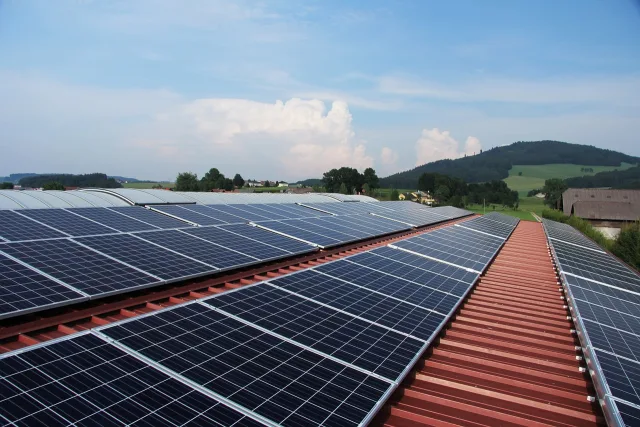
Installing photovoltaic panels
Energy
- Solution type
- Everyday action
- Theme
- Energy
Why install photovoltaic panels? There are several reasons to install photovoltaic (PV) panels: - A profitable investment: Depending on its power, a PV installation pays for itself in under 10 years nowadays and has a lifespan of more than 30 years. - A secure investment: With EDF OA and the S21 buy-back contract, it is possible to sell all or the surplus of one’s solar production at a guaranteed price for 20 years. - A durable investment: Manufacturers guarantee that around 80% of the initial output is maintained after 20 to 25 years of use of the panel. As evidence, the CSTB (Scientific and Technical Centre for Building) carried out a study confirming 91.8% of the initial output after 20 years of use. - An environmentally friendly investment: Although PV panels emit no CO₂ during use, a carbon cost of 40 to 55 g of CO₂ per kWh generated has been calculated, due to the manufacturing and transport stages of the panels. - Most photovoltaic panels are 95% recyclable. A 100% recyclable French panel recently appeared on the market. Soren is the non-profit eco-organisation approved by the public authorities for the collection and treatment of end-of-life photovoltaic panels in France. How to optimise your photovoltaic installation? Photovoltaic production depends on sunshine; it is what is called an intermittent energy. Several strategies can be put in place to maximise consumption according to production: - Installing control and automation tools (domestic hot water production, electric vehicle charging, etc.). - Reselling the electricity (EDF OA). - Installing storage batteries. - Etc.
- Sector:
- France
Its features
Environmentally friendly
• Long lifespan: Solar panels are guaranteed for up to 30 years and are considered functional for more than 40 years. • 95% made of recyclable materials: Glass, aluminium, silicon, copper and plastics are the materials used in manufacturing. • Low greenhouse gas emissions: Solar panels produce between 40 and 55 grams of CO₂ per kWh generated. By comparison, a gas-fired power plant produces around 443 gCO₂/kWh, while a coal-fired plant produces 1058 gCO₂/kWh.
Member map
Map tiles are unavailable. Positions and the list remain available.
No located members for this selection.