
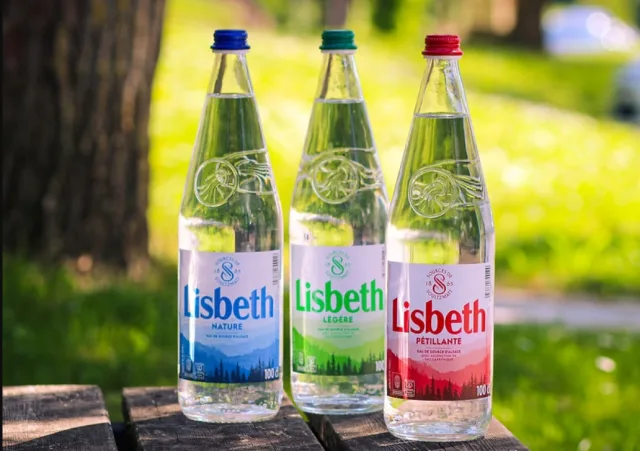
Spring water in a deposit glass bottle - LISBETH
Food and drink
- Solution type
- Product
- Theme
- Food and drink
A pioneer of the circular economy, the brand uses a deposit system for reuse: its glass bottles are washed and reused endlessly. It is a local hydration solution with a low carbon footprint, combining preservation of the water resource with the complete elimination of plastic packaging waste.
- Sector:
- Doubs, Bas-Rhin, Haut-Rhin, Territoire de Belfort
- Products concerned:
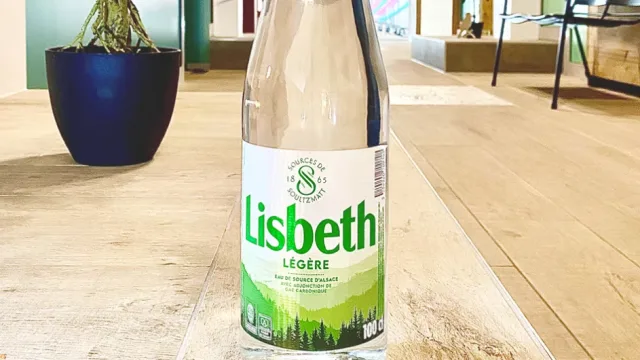
- Still / Light / Sparkling
Its features
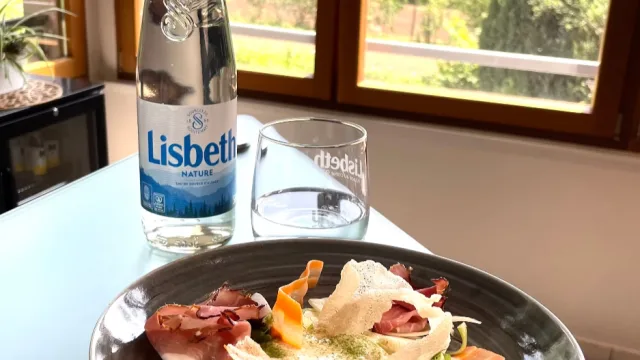
Deposit glass bottle
Glass has an exceptional lifespan. Under the deposit scheme, the bottle can be reused endlessly. After each use, it is collected, washed, inspected and refilled.
Drastic reduction of the carbon footprint
Reuse avoids the manufacture of new bottles (a very energy-intensive process). This local loop massively reduces CO₂ emissions linked to production and long-distance transport.
Energy efficiency
The production site continuously optimises its machines to limit energy consumption during the bottling and container-cleaning process.
Local spring
Lisbeth waters are drawn and bottled directly in Alsace, at Soultzmatt (68).
Circular logistics
By encouraging the return of empty bottles through points of sale and local distributors, Lisbeth supports a local economy and limits the kilometres travelled by each container.
Long life cycle
Thanks to its robustness, a Lisbeth bottle has an average service life of at least 6 years.
Intensive rotation
During its working life, the same bottle is collected, washed and refilled about 40 times.
Impact
This model avoids the manufacture and transport of 39 single-use bottles, drastically cutting the carbon footprint and the consumption of raw materials.
Endless circularity
Glass can be recycled endlessly. A Lisbeth bottle of today can thus become a Lisbeth bottle again tomorrow, creating a perpetual circular logic.
Life cycle of this solution
Step 1: The producer
Designs and bottles beverages while minimising environmental impacts across their life cycle.

Step 2: The transport provider
Transports the product from the producer to the distributor.
Take this placeStep 3: The distributor
Sells the products and raises Consomm’Acteurs’ awareness of reuse.
Step 4: The committed consumer
A player in eco-consumption, drinks the beverage and sorts the deposit bottle.
Take this placeStep 5: The collector
Collects the deposit packaging while checking its quality.
Step 6: The recovery operator
Takes back the bottle, handles the washing and its return into the circuit. The aluminium cap is collected and recovered.
Member map
Map tiles are unavailable. Positions and the list remain available.
Selected members (2)
- ADAM BOISSONSGuewenheim
- LES SOURCES DE SOULTZMATTSoultzmatt