
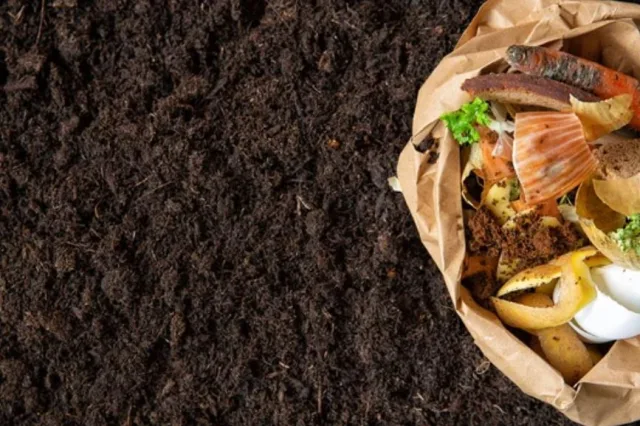
Sorting biowaste and setting up composting
Waste
- Solution type
- Everyday action
- Theme
- Waste
Why sort and recover your bio-waste? Bio-waste still accounts for a third of residual household waste (OMR) bins. Yet it has value. Instead of being landfilled or incinerated, green waste can be taken to a recycling centre or used directly in the garden. As for food waste, it could be composted or anaerobically digested for return to the soil, and the biogas produced from its treatment can replace fossil energy. The State has decided to act against this waste by passing a law requiring source separation of bio-waste from 31 December 2023, and it has entrusted ADEME with 100 million euros from its recovery plan to support the local authorities and businesses organising themselves to meet the obligation by the scheduled date. Some figures: 38% of residual household waste could be recovered organically. (Source: Modecom 2017) 6 Mt of waste could have been recovered organically in 2017. 68,783 t were collected separately (Source: Modecom 2017 survey) 157 local authorities had set up or were in the process of organising a separate collection of bio-waste in 2019. That is only 6% of the population. (Source: survey on the source separation of bio-waste in France, ADEME 2021, publication forthcoming) A substantial share of bio-waste can be recovered, but the means currently in place for collection by a third party are not developed enough. That is why on-site composting is of real interest from an ecological, economic and regulatory point of view alike. Where to place your compost? Several criteria should be considered when choosing the location of your compost. It is preferable to choose an accessible place, fairly close to where organic waste is produced and easy to reach in bad weather (think of avoiding rain, mud...) Always place the compost on bare earth, never on concrete or any other impermeable surface! Earthworms must be able to reach it to ensure good decomposition of the material 😊 It is recommended to place it on a flat storage surface where water does not accumulate, in a spot sheltered from the wind and preferably half shade, half sun (compost must be neither too wet nor too dry). There must also be enough room to aerate the compost when necessary. Which composter to choose? There are several ways to compost; what matters is to focus on the inputs rather than on the container. For large spaces, a simple windrow compost can do the job. There are also very attractive composters, notably wooden ones. You can even make them yourself using old untreated pallets fitted together. Be careful not to put a pallet as the bottom of the bin: as a reminder, compost must be in direct contact with the soil! Or again, plastic composters are plentiful on the market; they are less attractive and more fragile, but often cheaper... They can also do the job, provided they do not feed our planetary problem of plastic microparticles... The steps to prepare good compost 1. Select an ideal spot for your friend the compost 2. Some will say to turn over the top layer of soil, but this depends on its quality. If your soil is very hard (compacted, with a little moss on the surface), it is indeed advisable to loosen it a little. If this is not the case, you can start the layers of material straight away; the worms will take care of the rest. 3. At the start of the maturation of a compost, you can place a layer of dry plant debris such as straw or dead leaves at the bottom. Then add a layer of fresh plant material: grass clippings, “weeds”, if possible without seeds. Water the layers with rainwater if possible, as maturation needs a little moisture. 4. You can then add your organic waste as you go, such as plate scrapings, peelings, vegetable tops, green waste, etc. Always try to keep the ratio of 2/3 nitrogen-rich elements (which break down easily and are rather moist: grass clippings, leftovers, peelings), and 1/3 carbon-rich elements (drier and slower to break down: sawdust, dead leaves, pieces of cardboard or paper towels, etc.) From time to time you can add a thin layer of wood ash, rich in potash, which will kick-start decomposition. Your compost will be ripe after 8 to 18 months of decomposition. It should smell of nothing but good, rich earth and should be dark in colour, almost black. It will be perfect at the foot of your vegetable plants... Tip: when you start a new compost, do not hesitate to add a little of the old one to activate maturation.
- Sector:
- France
Its features
Environmentally friendly
- Reduction in the volume of residual waste and everything linked to it (transport, treatment, etc.), thereby reducing greenhouse gas production - Use of a natural product (organic fertiliser) for your garden, avoiding any chemical inputs - Contribution to ecological agriculture - Promotion of good soil composition and moisture
Second life
- Organic waste decomposes over time, forming excellent-quality compost that is very useful for gardening. End of life is therefore responsible and has no harmful impact on the environment.
Member map
Map tiles are unavailable. Positions and the list remain available.
No located members for this selection.